
Tech entrepreneur Tey El-Rjula aimes to positively influence the lives of billions of people. “We can use digital innovations and infrastructures to deliver quality education to everyone, including refugees, including the vulnerable ones.” Being a refugee himself he came up with the idea to use blockchain technology to create digital birth registration systems.
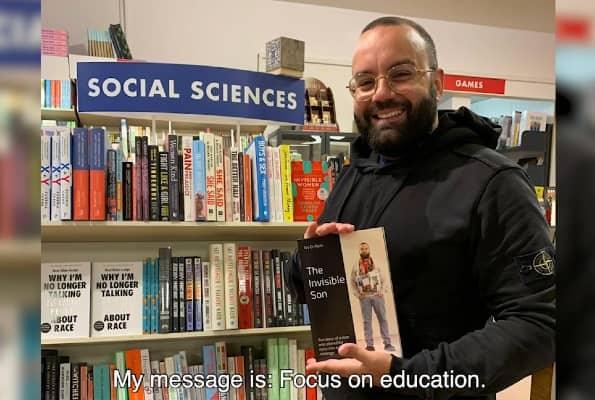
Tey El-Rjula with his book The Invisible Son
Tey El-Rjula was born in Kuwait to Syrian parents, and lost his own identity at the age of 5. He traveled through Lebanon, Dubai, Amsterdam and 5 refugee camps to grow into an “invisible man”. Someone with no identity and therefore no access to a bank account and to society.
As a digital native and an early adopter of Bitcoin, he managed to transform his life. Pioneering the use of blockchain to break financial and identity barriers, now holding a MSc in Digital Currencies and Blockchain Technology he works to transform the lives of many others too.
Turning invisible people into invincible ones
Living in a small room at the Ter Apel refugee camp in the Netherlands, Tey first came up with the idea to use blockchain technology to create digital birth registration systems.
It is expected that there will be 115 million unregistered children by 2030 in Sub-Saharan Africa alone, creating an ‘invisible generation’. A Birth certificate is crucial for accessing government services such as education and to reduce the risk of child being trafficked or ending up in child labor. Yet the births of one fourth of children under the age of 5 worldwide have never been officially recorded.
Apart from this, paper birth certificates can be lost it to wars or disasters: paper is fragile, easy to lose and can be hard to verify.
So Tey has launched a blockchain startup, which raised over €1.2 million in a mission to help the world’s “invisible children.”

Inspirational video: Tey El-Rjula
DownloadTey Elrjula - Entrepreneur:
There is no better opportunity to look at digital innovations than the time we're living in now.
Muziek speelt.
Beeldovergang in vormgeving Youth at Heart.
Tey Elrjula - Entrepreneur:
My name is Tey, I'm the author of the book The Invisible Son.
A tech entrepreneur in my day-to-day activities I aspire to be a billionaire in terms of influencing the lives of billions of people positively.
Quote from Tej Elrjula @ TEDx:
Bitcoin helped us break the financial barriers, can it help us break the identity barriers?
Tey Elrjula - Entrepreneur:
COVID for me is an opportunity to solve world-class challenges.
Such as physical money. Money can contract viruses and bacteria.
So being a Bitcoin expert, I'm able to accelerate the adoption of digital currencies.
My message is: Focus on education.
Today we can use digital innovations and digital infrastructures to deliver the same quality and even better education to everyone including refugees, including the vulnerable ones.
The youth is at the heart of any nation.
Join us at the digital conference and use your voice to make a difference.
Muziek speelt.
Beeldmerk Youth at Heart.
As Tey has devoted his life to help others with his knowledge and ideas, he states:
"Youth is at the heart of any nation. So join us at this digital conference and use your voice to make a difference”

Watch the virtual forum on YouTube
Do you want to hear more stories from youth in Africa and the Middle-East? The Dutch Ministry of Foreign Affairs organised the virtual forum Youth at Heart. Here young people from the Middle East and Africa discussed their experiences and thoughts about education, work and participation.
All sessions of the Youth at Heart virtual forum that was broadcasted on 2 November 2020, can be watched on our YouTube channel: Livestream 4 studio's on YouTube